
Fast Delivery! Order in-stock items before 7 p.m. CST Monday thru Thursday - get the next day!
loading content
Cutler-Hammer Series EGB1060FFG
EATON EGB1060FFG G Series Type EGB Molded Case Circuit Breaker With Metric Mounting Hardware, 347 V AC, 60 A, 25 kA at 240 V AC, 18 kA at 415 V AC, 18 kA at 480 V AC Interrupt, 1 Poles, Thermal Magnetic Trip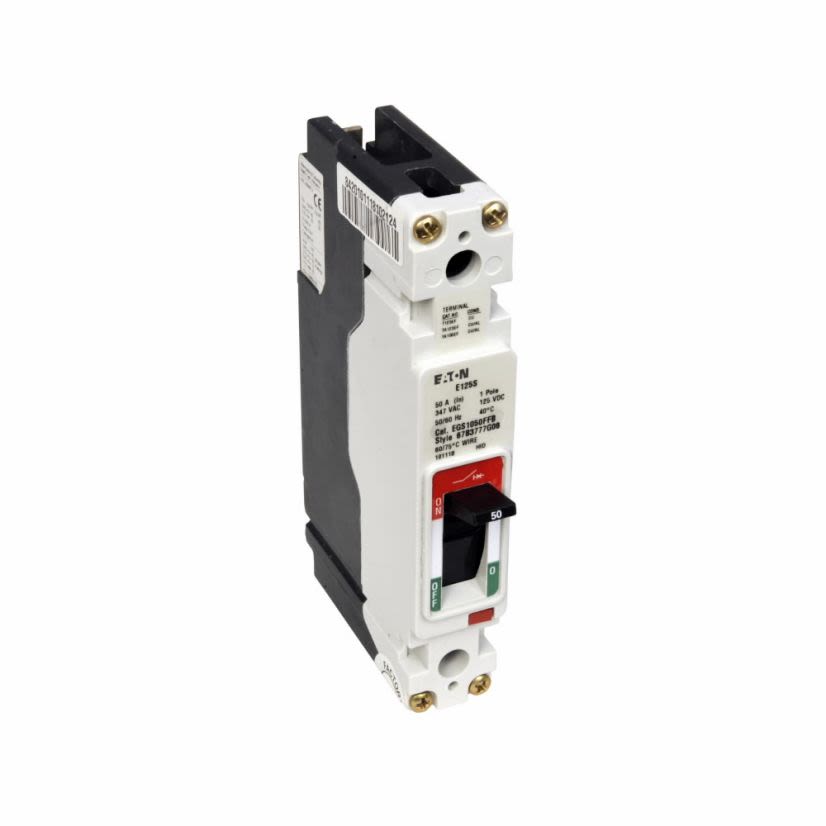
Cutler-Hammer Series EGB1060FFG
EATON EGB1060FFG G Series Type EGB Molded Case Circuit Breaker With Metric Mounting Hardware, 347 V AC, 60 A, 25 kA at 240 V AC, 18 kA at 415 V AC, 18 kA at 480 V AC Interrupt, 1 Poles, Thermal Magnetic TripNon-stock product. Available to order - lead time may vary.
BrandCutler-Hammer Series
MFG #EGB1060FFG
Werner Part #506817
UPC782114984659
Non-stock product. Available to order - lead time may vary.
BrandCutler-Hammer Series
MFG #EGB1060FFG
Werner Part #506817
UPC782114984659
Product Description
EATON Molded Case Circuit Breaker, Type EGB, Series: G Series, 347 V AC, 60 A, 50/60 Hz Frequency, 25 kA at 240 V AC, 18 kA at 415 V AC, 18 kA at 480 V AC Interrupt, EG Frame, Thermal Magnetic Trip, 1 Pole, 1 ph, Line/Load Connection, NEMA AB1-1993 Enclosure, 40 deg C, 2.99 in L x 1 in W x 5.5 in H Dimensions
Attributes
Documents
Applications
Included
Features
Attributes
Actuator TypeToggle Handle
Breaker TypeCH
Connection TypeLine/Load
Country of OriginDO
Dimensions2.99 in L x 1 in W x 5.5 in H
Enclosure Box SizeNEMA G
Enclosure TypeNEMA AB1-1993
FrameEG
Frequency Rating50/60 Hz
Housing MaterialMetal
Interrupt Rating25 kA at 240 VAC, 18 kA at 415 VAC, 18 kA at 480 VAC
ManufacturerEaton
Mounting TypePlug-On
Number of Circuits42
Number of Poles1
Number of Spaces42
Package Length6.25 in
Package TypeEACH
Package Weight1.5 lb
Package Width1.38 in
Phase1
SeriesG Series
Size of Wire4 AWG to 300 kcmil
Temperature Rating40 deg C
Trip TypeThermal Magnetic
TypeType EGB
Voltage600Y/347 VAC
Wiring Configuration3-Wire
Documents
Applications
Electrical, Machinery OEMs, Earth Leakage and Current Limiting Breakers Applications
Included
Frame, Trip Unit, Standard Terminals
Features
- Compact design frees up panel space
- Common field fit internal accessories make installation and custom configuration easy
- Advanced trip unit functionality offers a wide range of adjustment for maximum flexibility
- Patented contact design features high speed blow open action, resulting in superior performance
- Circuit breakers significantly outperform the calculations listed in the institute of electrical and electronic engineers (IEEE) standard 1584-2002, guide for performing arc flash hazard calculations